

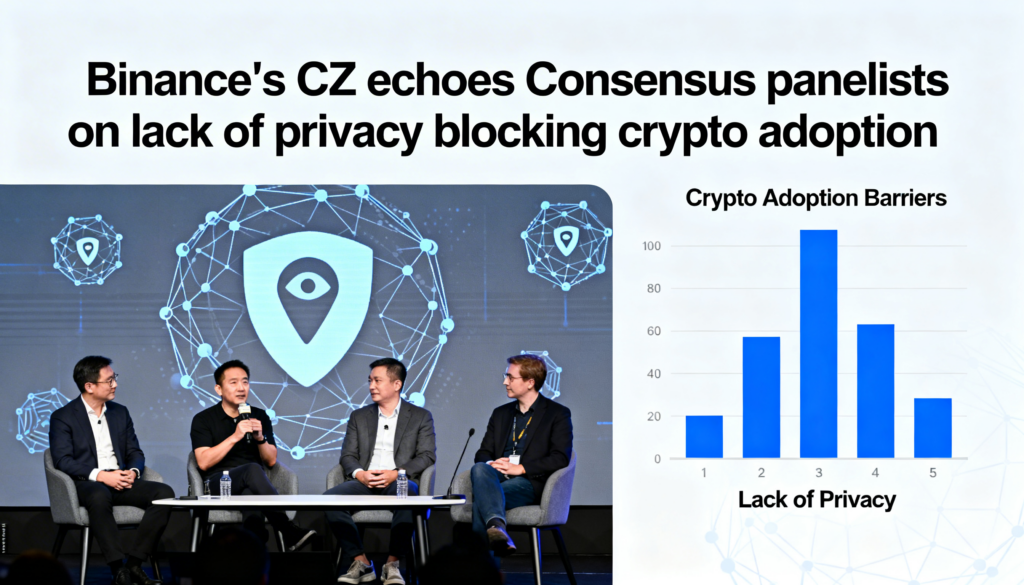
Concerns over transparency on public blockchains are emerging as a major hurdle to wider crypto adoption, with both retail advocates and institutional executives arguing that insufficient privacy is limiting real-world use cases.
Changpeng Zhao, widely known as CZ, said the absence of meaningful privacy protections is restraining crypto’s evolution into a viable payments system. The co-founder of Binance echoed sentiments expressed by panelists at CoinDesk’s Consensus conference in Hong Kong, where industry leaders debated what must change for blockchain to achieve mainstream institutional traction.
Public blockchains are often praised for their transparency, offering open, verifiable transaction records that contrast with opaque traditional finance systems. Yet that same transparency can expose sensitive financial information. Wallet balances, payment amounts and transaction histories can frequently be traced, raising concerns for individuals and corporations alike.
Zhao highlighted a practical example: companies paying salaries in crypto. In today’s environment, he noted, on-chain payroll could effectively reveal compensation details to anyone monitoring wallet addresses.
Institutional participants voiced similar reservations. During a panel discussion on the outlook for institutional markets, Fabio Frontini, CEO of Abraxas Capital Management, argued that full transparency is not necessarily desirable for large financial transactions.
While transactions should be auditable, Frontini said, visibility should be restricted to appropriate parties rather than publicly accessible by default. For institutions handling sizable capital flows, confidentiality remains critical.
The debate follows recent experiments with tokenized traditional financial instruments. In December, JPMorgan Chase facilitated a $50 million commercial paper issuance for Galaxy Digital on the Solana network. The deal, which involved settlement in Circle’s USDC stablecoin and participation from Coinbase Global and Franklin Templeton, demonstrated how public blockchains can streamline issuance and settlement.
However, the transaction also underscored the tension between efficiency and privacy. Emma Lovett, credit lead for the Markets Distributed Ledger Technology team at JPMorgan, said institutions need confidence that their on-chain activity cannot be easily mapped by outside observers.
Without safeguards to prevent address-level surveillance, large-scale asset migration to public chains is unlikely, panelists suggested.
Thomas Restout, CEO of institutional liquidity provider B2C2, added that beyond privacy, institutions require certainty of execution and trusted infrastructure. Major financial firms do not test new systems with small allocations; they must be confident the framework can support operations at massive scale.
Until public blockchain systems address privacy concerns and deliver institutional-grade reliability, both everyday users and Wall Street players may remain cautious about fully embracing on-chain finance.
About The Author





More Stories
U.S. Adds Just 29,000 Jobs in September as Unemployment Rate Hits 4.2%
Bitcoin Dominance Nears 60% as Crypto Traders Shift Into Risk-On Mode
Bitcoin Open Interest Surges $2.3B as Traders Increase Bullish Bets