

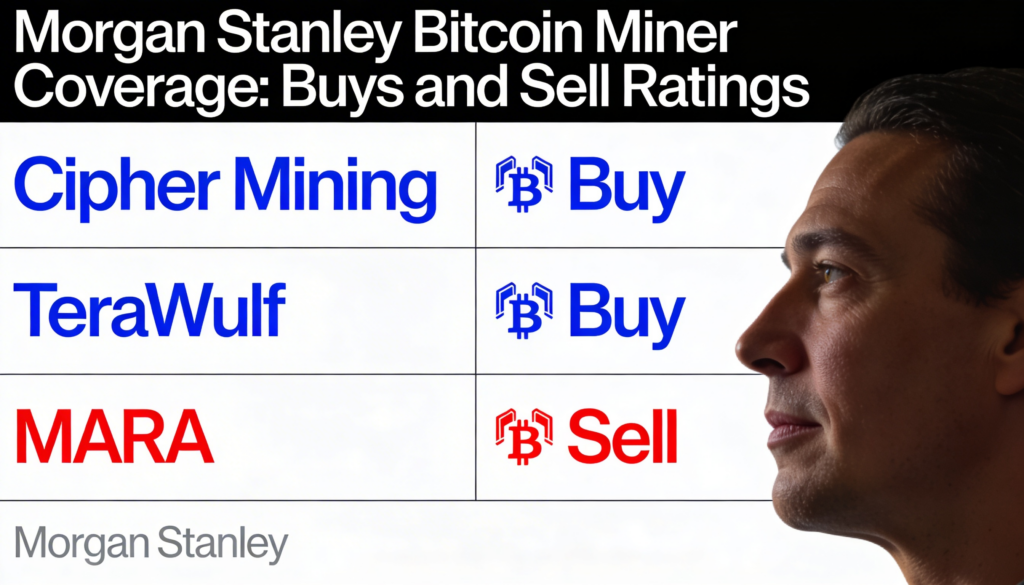
Morgan Stanley Favors Infrastructure-Linked Miners, Downgrades MARA in Coverage Launch
Morgan Stanley initiated coverage of three publicly traded bitcoin (BTC) miners on Monday, taking a differentiated view that favors companies evolving into data center infrastructure plays over those maintaining heavy exposure to bitcoin price volatility.
Analyst Stephen Byrd and his team began coverage of Cipher Mining (CIFR) and TeraWulf (WULF) with Overweight ratings and price targets of $38 and $37, respectively. Shares of CIFR jumped 12.4% to $16.51, while WULF rose 12.8% to $16.12.
Marathon Digital (MARA), by contrast, was initiated at Underweight with an $8 price target. The stock was modestly higher on the day at $8.28.
Byrd’s thesis centers on the idea that certain bitcoin mining facilities should be valued less as speculative crypto operations and more as infrastructure assets. Once a miner develops a data center and secures a long-term lease with a creditworthy tenant, the asset’s appeal shifts toward investors seeking stable, contracted cash flows rather than bitcoin-driven upside.
He likened these facilities to data center REITs such as Equinix (EQIX) and Digital Realty (DLR), which trade at more than 20 times forward EBITDA. Investors assign premium valuations to those companies due to their scale, diversification and predictable growth. While Byrd does not expect single-site assets developed by bitcoin miners to command similar multiples, he believes the market may be undervaluing their long-term cash flow potential.
Cipher Mining is central to that view. Byrd described its portfolio as fitting a potential “REIT endgame,” where contracted data centers are ultimately valued by infrastructure-focused investors. In such a scenario, a site that transitions from self-mining to leasing capacity to a hyperscale or cloud customer would resemble a utility-like asset with steady, predictable returns and reduced bitcoin exposure.
TeraWulf received similar treatment. Byrd highlighted the company’s experience securing data center agreements and management’s background in power infrastructure development. He estimates the company could convert uncontracted sites at a present value of roughly $8 per watt. His base case assumes TeraWulf achieves about half of its targeted 250 megawatts of annual data center growth between 2028 and 2032, with upside if execution reaches 75% of that goal.
The outlook was more cautious for Marathon Digital. Byrd argued that MARA offers limited upside from bitcoin-to-data-center conversions due to its hybrid model, which maintains significant mining exposure while pursuing data center initiatives. The company’s strategy of maximizing bitcoin exposure — including issuing convertible debt to purchase additional BTC — further ties its valuation to mining economics.
Marathon’s relatively limited experience in hosting data center clients also weighed on the rating. According to Byrd, bitcoin mining fundamentals remain the primary driver of MARA’s stock performance.
That reliance presents risks. Morgan Stanley sees both near- and long-term challenges to mining profitability and noted that the industry’s historical returns on invested capital have been unattractive.
The initiation reflects a broader debate over whether bitcoin miners should transition into power and computing infrastructure providers. Morgan Stanley’s position is selective: companies that lock in long-term, contracted data center revenue may warrant infrastructure-style valuations, while those remaining primarily tied to bitcoin price dynamics face a more uncertain outlook.
About The Author





More Stories
Live Updates: Risk Assets Slide as Bond Selloff and Oil Rally Intensify
Bitcoin Falls Below $83,000 as Ethereum Researcher’s ‘Bunker Mode’ Warning Sparks Debate
Ripple Earns Fees by Financing Leveraged Stock Bets Once Dominated by Banks