

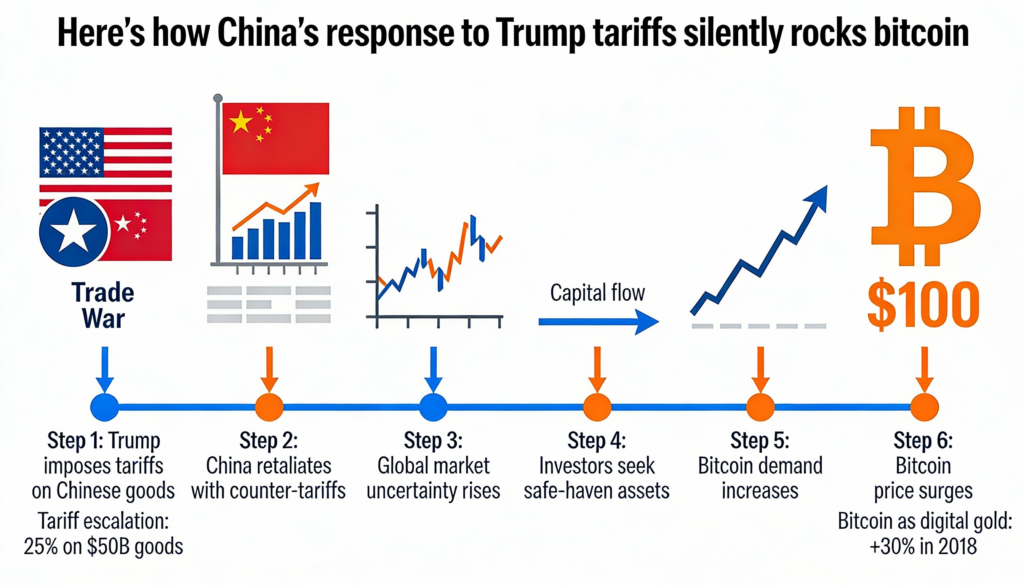
China’s exports are holding up under U.S. tariffs, with tightly managed yuan dynamics sending knock-on effects into crypto markets.
China’s response to President Donald Trump’s aggressive trade agenda is quietly reshaping global liquidity flows—ripples that are now being felt even in bitcoin markets.
Since returning to office early last year, Trump has imposed sweeping import tariffs on nearly all goods entering the United States, including those from China, the world’s second-largest economy and its dominant manufacturing hub. As of January 2026, the average U.S. tariff on Chinese imports stands at roughly 29.3%.
Rather than retaliate through overt currency devaluation, Beijing has adapted by maintaining tight control over the yuan’s exchange rate—a strategy that has helped cushion the impact of tariffs while preserving export competitiveness.
According to a recent JPMorgan note, China’s exchange-rate management has played a critical role in sustaining exports and containing deflationary pressures. At the same time, it has amplified dollar-driven liquidity cycles during periods of heightened trade stress.
In practical terms, China’s currency framework tends to intensify dollar liquidity swings when trade tensions escalate—exacerbating the global “risk-off” environment rather than offsetting it.
That dynamic matters for bitcoin, which has increasingly traded as a macro-sensitive asset. The cryptocurrency typically struggles when tariff-driven uncertainty tightens dollar liquidity and rebounds when those pressures ease. This pattern was evident during March and April last year, when bitcoin sold off sharply amid escalating trade frictions before recovering as conditions stabilized.
China’s influence on crypto prices appears to operate indirectly, through currency management and global liquidity transmission, rather than through direct capital flows. That contrasts with the U.S., where bitcoin demand is increasingly shaped by investment vehicles such as exchange-traded funds and other regulated products.
This interpretation aligns with views expressed by Arthur Hayes, who has argued that U.S.–China trade disputes are largely performative at the political level, with the real economic adjustments occurring through less visible channels.
In that framework, tariffs and negotiations provide the narrative backdrop, while foreign-exchange policy, capital-account controls, and Treasury-led liquidity management ultimately determine market outcomes.
JPMorgan’s outlook reinforces this view. While China is unlikely to allow the yuan to strengthen meaningfully, the interaction between tariffs, managed FX policy, and dollar liquidity continues to shape the macro environment in which bitcoin trades.
China’s export resilience
According to JPMorgan Private Bank’s latest Asia outlook, China’s export engine remains notably resilient. Real exports are projected to grow around 8% in 2025, with China’s global market share rising to approximately 15%, despite an increasingly dense web of U.S. tariffs. Exports destined for the U.S. now account for less than 10% of China’s total shipments.
That resilience reflects both geographic diversification—particularly toward ASEAN economies—and a deliberate policy choice to tightly manage the yuan rather than allow sustained appreciation.
While the yuan has strengthened about 4% over the past year from its 2023 lows, it is only marginally higher against the dollar on a calendar-year basis in 2025. This underscores how tightly controlled and range-bound the currency remains.
JPMorgan notes that any recent yuan strength is likely seasonal. Over the medium term, policymakers are expected to maintain a stable trading range as they prioritize export competitiveness and confront persistent deflationary pressures.
The bank cautioned that the threshold for meaningful yuan appreciation remains high, describing China’s FX regime as a low-volatility framework in which movements are largely dictated by the dollar’s direction.
For crypto markets, that setup shifts attention away from sustained yuan appreciation and toward the transmission of global liquidity—where the real impact of trade policy continues to be felt.
About The Author




More Stories
Bitcoin Falls Below $82K as AI Fears Resurface and DeFi Tokens Sink
Crypto Traders Value Reliance Jio IPO at $110 Billion
Asian Markets Slide as Bitcoin Pulls Back and China Enters Bear Territory