

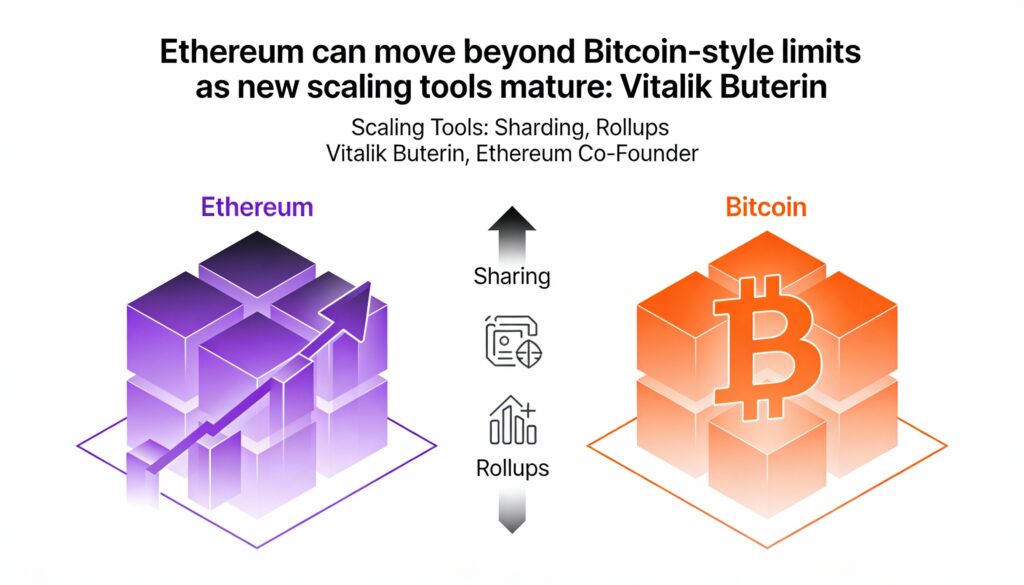
Ethereum is approaching a major inflection point as two key upgrades — PeerDAS and zkEVMs — advance from research into deployable technology, according to co-founder Vitalik Buterin.
In a post on X, Buterin said the pairing could transform Ethereum into “a fundamentally new and more powerful kind of decentralized network” by addressing the core limitation that has long constrained blockchains: the tradeoff between decentralization and consensus on one side, and bandwidth and throughput on the other.
He illustrated the challenge by contrasting two internet-era architectures. Decentralized file-sharing systems such as BitTorrent can handle large volumes of data but do not require consensus. Bitcoin, meanwhile, prioritizes decentralization and consensus, but remains low-bandwidth because each node independently verifies the same computations rather than dividing the work.
Ethereum’s next phase, Buterin said, is about combining all three properties at once.
One piece of that vision is already in place. PeerDAS, a data availability sampling mechanism, is now live on Ethereum’s mainnet, allowing nodes to confirm that transaction data exists without downloading it in full. The system serves as an early implementation of Data Availability Sampling, a critical component of Ethereum’s sharding-based scaling roadmap.
By enabling light clients to verify shard data through small, random samples, PeerDAS improves scalability while preserving security and decentralization.
The second upgrade, zkEVMs, has reached what Buterin described as production-grade performance. At this stage, development is focused on safety and demonstrating reliability at scale rather than further performance gains.
Buterin said the progress represents a practical step toward resolving the blockchain “trilemma” through live, running code, adding that zkEVM nodes could begin appearing in limited form in 2026.
Looking further ahead, he pointed to distributed block building as a longer-term objective, where no single party assembles an entire block, reducing censorship risks and improving geographic fairness.
Overall, Buterin’s message was that Ethereum’s scaling strategy is increasingly centered on distributing verification work across the network, rather than requiring every node to replicate the full workload.
About The Author





More Stories
Ether Faces Loss of Major Buyer as Tom Lee Says Bitmine Will Halt Purchases
Bitcoin Recovery Stalls Before Bringing Last Underwater Holders Into Profit
Crypto Liquidations Hit $547 Million as Oil Rally Weighs on Markets